
Pong Pong Mahjong 2
Microgaming Slot Review
 Powered by SlotsReach.com
Pong Pong Mahjong 2: Slot Overview
Released on 28 January 2026, Microgaming’s Pong Pong Mahjong 2 shares its name with the studio’s earlier Pong Pong Mahjong and runs at an RTP of 96.19%, against 96.94% listed for the original. Set on a 5-reel, 4-row, 1,024-ways cascading grid with medium volatility and a 7,000x stated top win, the game builds its entire loop around two connected table features: an overhead multiplier trail and a four-sided border called the Pong Area. Above the board, the cascade trail starts every base spin at x1 and climbs through x2, x3, and x5 on consecutive tumbles before resetting between spins. Around the outer edges of the grid sit four recessed trays, Top, Left, Bottom, and Right, each holding three face-down golden tiles tied to a symbol modifier: Wild conversions on top, instant Coins on the left, Multipliers on the bottom, and locking Respins on the right.
It is a clever tabletop layout, even if it sits between two oddly drawn caricature hosts and locks its main attraction behind a first-cascade catch. Because the active Pong Area tray stays face-down in the base game until a spin lands a winning tumble first, the rotating trays never rescue a dead spin, making the jump into the bonus rounds, where the tray opens immediately on every drop, feel like playing with the brakes finally taken off.
A Sharp Mahjong Parlor Flanked by Frozen Hosts
Look solely at the table in the center of the room and Pong Pong Mahjong 2 has the quiet polish of a high-end parlor. Calm teal silk walls patterned with traditional wave motifs frame an emerald-green felt surface edged in gold. Even when cascades are dropping at full speed, the glossy ivory tiles stay crisp and effortless to tell apart, with deep recessed carvings separating the bamboo sticks, circles, and character suits from the directional Winds and the three Dragons. Around the four borders, a neon-green highlight steps counter-clockwise from tray to tray on each spin to mark which set of face-down golden tiles is waiting for a cascade.
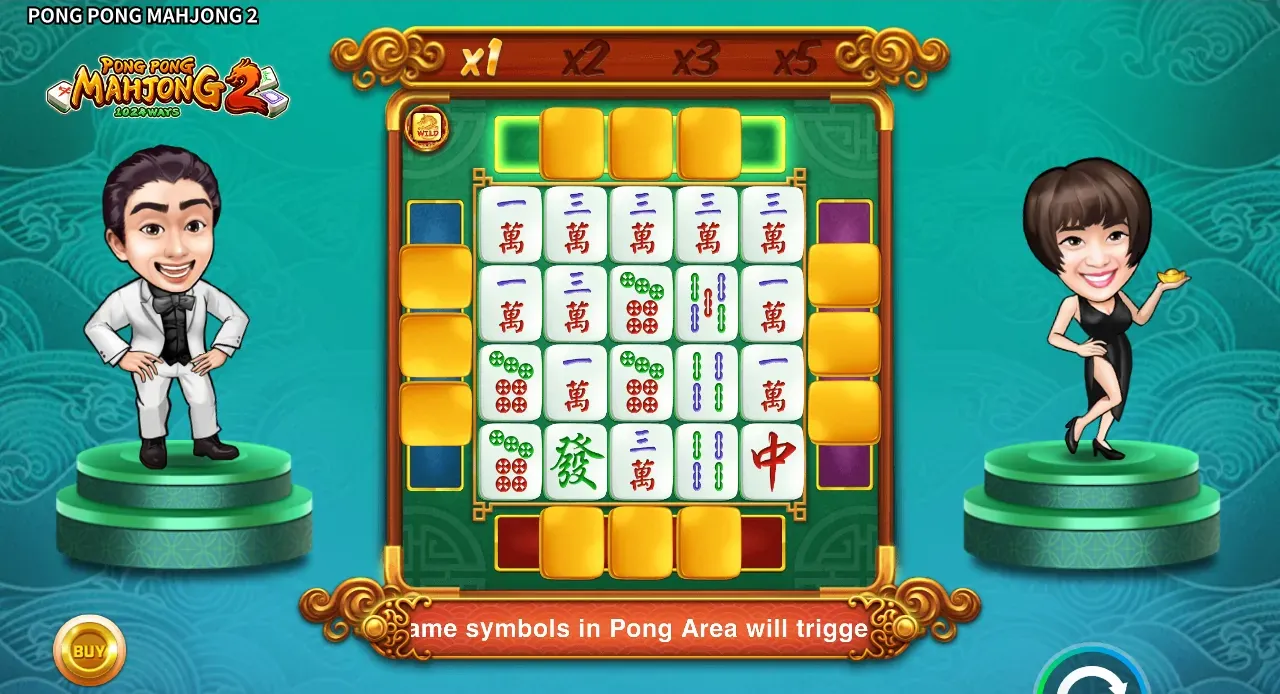
Then your gaze drifts to the circular stage pedestals on either side of the felt, and the mood gets weird. On the left stands a grinning man in a white tuxedo with his hands planted on his hips; on the right, a woman in a slit black cocktail dress balances a tiny gold sycee ingot on an open palm. Both look like mid-2000s caricature cutouts, with photorealistic smiling heads pasted onto miniature cartoon bodies, the female host’s head is nearly as wide as her torso. Stranger still is how little they care about what happens on the table between them. When the purple dragon scatter slams onto reel 5 in a shower of golden sparks, neither emcee flinches; both stay frozen in their default poses, staring blankly out at the room.
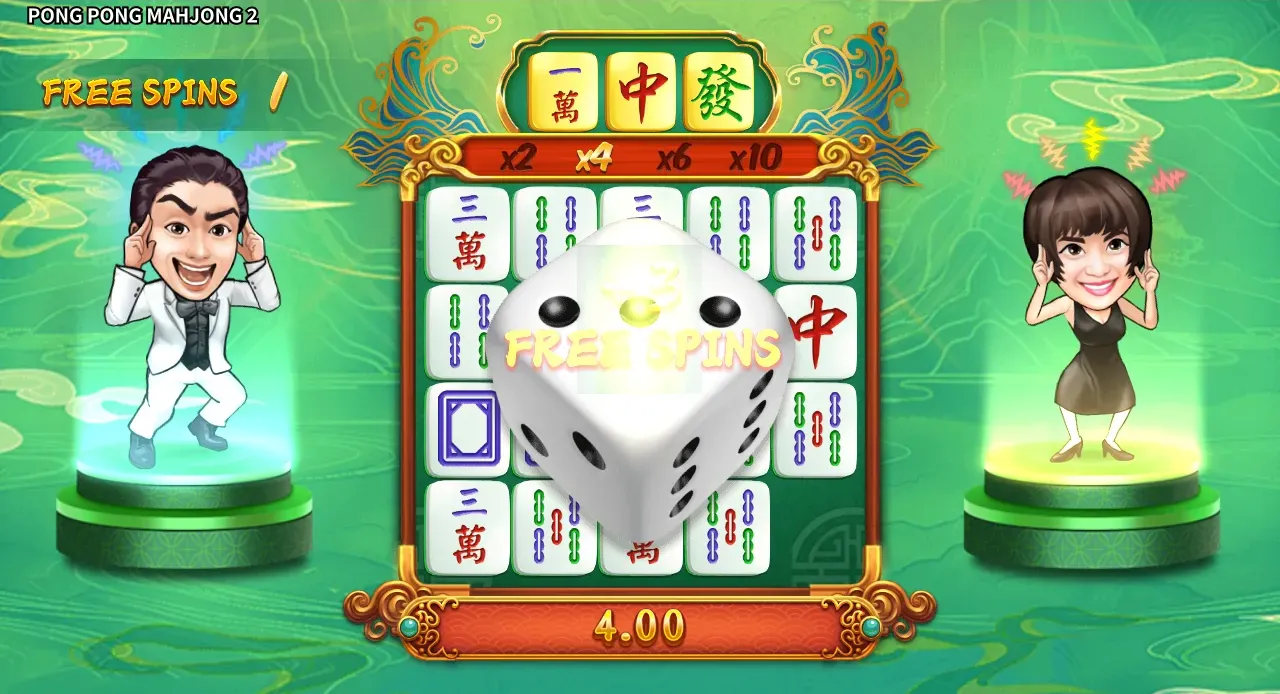
Triggering a bonus round rebuilds the room around the board. The four side trays disappear and merge into a single dragon-crested golden alcove at the top of the frame while drifting clouds roll across the backdrop. In regular Free Spins, the parlor shifts to a cool jade green, the pedestals glow like stage spotlights, and a heavy 3D white die tumbles across the Mahjong tiles to award extra spins, the one moment in the entire game that finally jolts the hosts awake, making both of them lift a foot, press their fingers to their temples, and shoot cartoon zig-zags of electricity from their oversized heads. Step up into the crimson-and-gold Dragon Free Spins, where the main grid dims into shadow and matching tiles erupt in swirling rings of golden fire, and both hosts go right back to standing motionless beside the flames.
Base Game: Sub-Stake Tiles and the Rotating Pong Area
The bottom of the paytable is flat. Every three-of-a-kind combination short of the Wild pays back only a fraction of the stake: all five suit tiles share the same 0.1x to 0.5x payout tier, the four Winds pay 0.2x to 1x, and even the top-ranked Red Dragon starts at 0.6x for three of a kind before reaching 5x for a full five-reel way. Single-step hits barely chip away at the cost of a spin, so base-game returns depend on multi-way stacks or chaining enough cascades to push the overhead multiplier trail from x1 through x2, x3, and x5.
That cascade requirement also governs the Pong Area. As the active highlight steps counter-clockwise, Top, Left, Bottom, Right, from spin to spin, the three golden tiles in the active tray only flip face-up after the initial drop produces a winning cascade. Once the tray opens, all three revealed tiles have to match each other and match a symbol currently sitting on the main grid after the tumble settles. Because of that double hurdle, the Pong Area sits idle on every non-winning spin, though whenever the Top, Left, or Bottom tray does fire, the cascade trail has already stepped to at least x2:
- Wild Feature (Top): Every matching symbol on the main grid turns into a Dragon Wild, which substitutes across all connected ways and pays up to 10x for five of a kind on its own, or up to 50x per way if the base cascade trail has reached x5.
- Coin Feature (Left): Matching tiles flip into instant cash Coins that pay their displayed values from anywhere on the board, regardless of whether they sit on connected ways.
- Multiplier Feature (Bottom): Matching tiles on the grid carry multipliers.
- Respin Feature (Right): Matched tiles lock in place while the rest of the board respins, and any new matching tile locks too, until a respin locks nothing new.
Triggering the Bonus and What 7,000x Means on This Board
Landing three red 胡 coin Scatters anywhere on the reels triggers 10 standard Free Spins, while landing two standard Scatters alongside the purple dragon Special Scatter on reel 5 upgrades the round to 10 Dragon Free Spins. Every extra Scatter beyond the third adds 2 more spins to the starting tally. How you enter the feature determines how your Pong modifier is chosen: a natural scatter trigger locks in whichever Pong Area edge was active on the triggering spin for the whole bonus round, whereas using the feature buy sends you to a starter wheel that spins to assign Wilds, Coins, Multipliers, or Respins at random.
Inside either bonus round, the single top Pong alcove opens on the initial drop of every free spin instead of waiting for a cascade, and the overhead multiplier trail doubles to start at x2 before climbing to x4, x6, and x10 on consecutive tumbles (resetting between spins, with the rolling 3D white die adding extra spins along the way). Because the alcove reveals its three tiles right away, the modifier can create the first win of a spin by itself at a minimum x2 multiplier.
That doubled trail is the best place to read the game’s 7,000x figure. It is the studio’s stated maximum win, a simulation high rather than a hard cap, and it is not stated which mode produced it. At the top x10 step of the free-spins trail, a five-of-a-kind Wild way pays 100x on its own, and both buys play that same top step. At the 20.00 top bet, 7,000x comes to 140,000.00.
40x Free Spins vs. 100x Dragon Free Spins
In the demo, stakes run from 0.20 to 20.00 per spin. Buying standard Free Spins at 40x the bet costs 8.00 at the minimum stake and 800.00 at the 20.00 ceiling, while the 100x Dragon Free Spins buy runs from 20.00 up to 2,000.00.
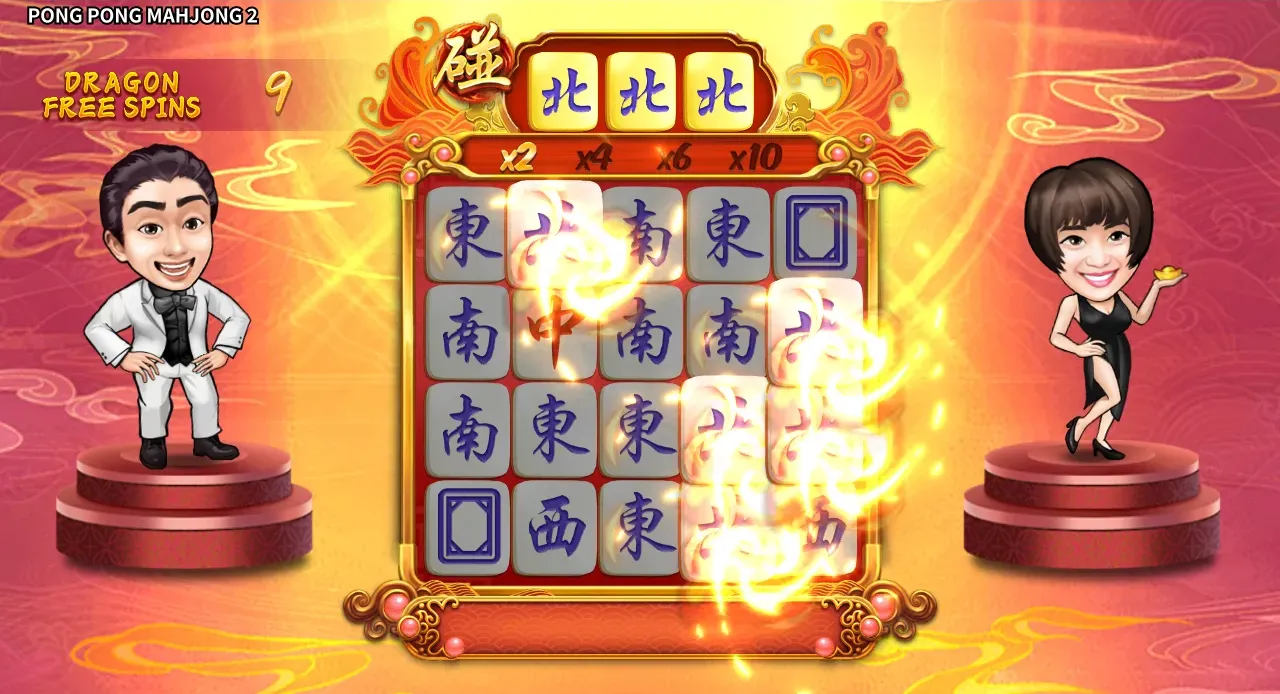
Paying 2.5 times as much for Dragon Free Spins does not change the x2 to x10 multiplier trail or the four Pong modifiers; instead, it strips all five bamboo, circle, and character suit tiles off the board for the duration of the feature. That single change alters the math in two ways at once. Removing the 0.1x to 0.5x suit tiles makes the 0.2x to 1x Winds the lowest symbols left on the reels, raising the floor of the paytable. More importantly, cutting the symbol pool from twelve tile types down to just seven, the four Winds and three Dragons, clears out the low-value clutter inside both the main grid and the top Pong alcove, giving the three shrine tiles and the 1,024 ways a much tighter pool to match against.